Epoxy Flooring Durability for Northern Homes: 2026 Guide
Table of Contents
What Is Epoxy Flooring and Why Northern Homes Choose It
Epoxy vs Polyaspartic for Cold Climates: Which Lasts Longer?
Why Temperature Controls the Cure
The Practical Comparison
The Working-Time Trade-Off
Cold-Weather Installation Realities
Which System for Which Space
How to Prepare Concrete for Epoxy: The Step That Decides Durability
Freeze-Thaw Cycles, Vapor Barriers, and Moisture Vapor Transmission
How Freeze-Thaw Actually Breaks a Coating
Testing for MVT Before You Coat
Vapor Barrier Options
Slip Resistance for Wet and Icy Conditions
Epoxy Floor Maintenance Tips for Long-Term Performance
Residential Epoxy Flooring Cost Factors: What Drives the Price
Frequently Asked Questions
Last Updated: September 15, 2026
What Is Epoxy Flooring and Why Northern Homes Choose It
Epoxy flooring is a resin-based coating that bonds to a prepared concrete substrate, forming a seamless, hard-wearing surface. In northern homes, that bond faces freeze-thaw cycles, road salt, and slab moisture from day one. This guide from Northern Escapes Services covers what determines epoxy flooring durability in northern homes, from surface preparation through curing.
Durability comes down to three things: how well the concrete was prepped, what the slab is doing underneath, and which coating chemistry you chose for a cold climate. Get any one wrong and the floor fails early, usually by delamination, the coating peeling away in sheets.
Below, we cover the prep step that decides everything, the epoxy vs polyaspartic question for cold climates, freeze-thaw and vapor barrier requirements, maintenance, and residential epoxy flooring cost factors.
Factor | Why It Matters in a Cold Climate | Typical Failure If Ignored |
Surface preparation | Coating needs a profiled, clean substrate | Delamination within one season |
Moisture vapor transmission | Slab moisture pushes coating off from below | Blistering, bubbles, peeling |
Coating chemistry | Cure speed and flexibility vary by temperature | Slow cure, brittleness, cracking |
Curing temperature | Epoxy needs warmth to cross-link properly | Soft, tacky, undercured floor |
Slip resistance | Wet, icy boots on smooth coatings | Slipping injuries |
Epoxy vs Polyaspartic for Cold Climates: Which Lasts Longer?
Polyaspartic topcoats generally outlast standard epoxy in cold climates because they cure faster at low temperatures and resist UV yellowing, while epoxy remains the better base coat for most residential slabs. The strongest system for a northern home is usually an epoxy base plus a polyaspartic topcoat.
Why Temperature Controls the Cure
Both are two-component systems: a resin and a hardener that react once mixed. That reaction is temperature-dependent; warmer material and substrate cross-link faster, colder ones slower. Manufacturer data sheets specify a minimum application temperature, commonly around 15°C (about 60°F) for standard epoxy, and applying below that range produces a floor that never fully cures.
An undercured epoxy floor stays soft and tacky, with reduced chemical and abrasion resistance, and remains vulnerable to indentation and staining for its entire service life. Warming the room later does not reverse it.
Polyaspartic cures by a different reaction pathway that is much less sensitive to low temperature, so it cures where standard epoxy will not, the biggest reason it dominates cold-climate installations.
The Practical Comparison
Property | Standard Epoxy | Polyaspartic |
Cure speed at low temperature | Slow; may not cure below rated minimum | Fast; cures at cooler temperatures |
UV stability | Yellows and ambers under sunlight | UV stable; color holds |
Working time after mixing | Long; forgiving for large areas | Short; demands speed and experience |
Cost per square metre | Lower | Higher |
Best role in a system | Base coat: adhesion, build, impact strength | Topcoat: wear layer, color stability |
The Working-Time Trade-Off
Polyaspartic's fast cure is also its drawback: working time is often measured in minutes rather than the tens of minutes standard epoxy allows. A rushed application shows as roller marks, uneven texture, and lap lines, so installer experience matters more with polyaspartic.
Cold-Weather Installation Realities
A few practical points that apply to either system in a northern home:
Slab temperature, not air temperature, is the number that matters. Concrete holds cold well into a mild day; a 18°C (65°F) afternoon can still mean a 10°C (50°F) slab.
Heating the space is often part of the job. Temporary heat may be needed for the full cure window, adding to schedule and cost.
The recoat window is temperature-dependent. Miss the manufacturer's window and the bond between coats suffers.
Cure time before foot and vehicle traffic is longer in the cold. Plan on keeping the space empty longer than a summer install.
Pro Tip Ask your contractor what the slab temperature will be on install day, not the air temperature. Concrete stays colder than the air and holds that cold, so a mild afternoon can still mean a slab too cool for standard epoxy to cure correctly.
Which System for Which Space
For an unheated garage in a northern climate, the epoxy-base/polyaspartic-top combination is standard: epoxy provides adhesion and build, polyaspartic a fast-curing, UV-stable wear layer. For a heated basement or mudroom, standard epoxy may suffice if the space stays within the manufacturer's temperature range year-round. The deciding factors are temperature profile, sun exposure, and traffic, not the product label.
Key Takeaway The system matters more than the brand. An epoxy base with a polyaspartic topcoat, applied to a properly prepared and moisture-tested slab at the right temperature, will outperform a premium single-product floor applied to a cold, damp slab every time.
How to Prepare Concrete for Epoxy: The Step That Decides Durability
Surface preparation decides whether the coating stays bonded for years or peels within months. Diamond grinding is the standard method: it opens the concrete's pores and creates the mechanical profile epoxy needs to grip.

The preparation sequence matters as much as the method:
Assess the slab. Check for existing coatings, cracks, and contamination. Old sealers must come off completely.
Repair defects. Fill cracks and spalls before grinding, not after.
Diamond grind the surface. This removes the top layer and creates the profile the coating needs.
Test for moisture. A moisture test tells you whether a vapor barrier is required before any coating goes down.
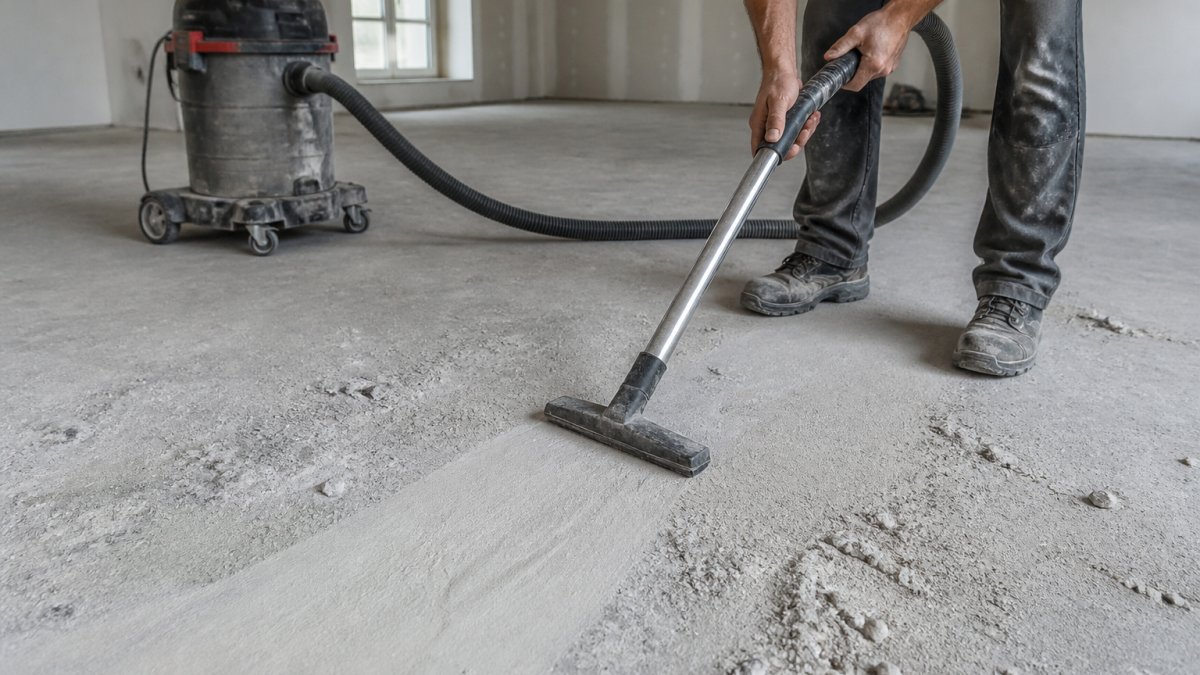
Clean and vacuum. Dust left on the surface becomes a release layer and causes delamination.
Apply primer, base, and topcoat within the manufacturer's recoat window.
A common mistake is skipping the moisture test because the floor looks dry. Concrete can look and feel dry while still transmitting vapor from below, which pushes the coating off from underneath.
Freeze-Thaw Cycles, Vapor Barriers, and Moisture Vapor Transmission
Moisture vapor transmission (MVT) is the upward movement of water vapor through a concrete slab, driven by the temperature and vapor-pressure difference between the soil below and the air above. In a heated northern home, that gradient is strongest in winter, and without an under-slab barrier, the vapor arrives at the underside of your coating with nowhere to go.
The failure mechanism is hydraulic: vapor pressure builds at the bond line until it exceeds the coating's adhesion strength, and the epoxy releases, first as blisters, then as sheets. That is why a floor perfect in October can be peeling by February.
How Freeze-Thaw Actually Breaks a Coating
Water expands roughly 9 percent by volume when it freezes. In a northern slab, that expansion happens in three places that matter:
Within the slab's pore structure. Repeated freeze-thaw develops internal cracking, weakening the substrate the coating bonds to.
At unsealed edges and control joints. Water enters at the perimeter, freezes, and pries the coating edge upward; traffic and moisture then work it loose.
Under the coating itself. Trapped vapor that condenses and refreezes at the bond line acts like a slow hydraulic jack until adhesion fails.
A well-bonded, fully sealed system tolerates this because the coating moves with the slab and no water reaches the bond line. A system with a lifted edge, an unsealed joint, or a saturated slab does not.
Testing for MVT Before You Coat
The standard field method is the calcium chloride test, which measures the rate of moisture vapor emission over 60 to 72 hours in pounds per 1,000 square feet per 24 hours. According to the Concrete Council of Canada, MVT rates exceeding 3 pounds per 1,000 sq ft per 24 hours often require a vapor barrier.
A practical sequence for a northern slab:
Vapor Barrier Options
Watch Out Applying epoxy over a slab with high moisture vapor transmission and no barrier is the most expensive mistake in this category. The coating blisters and peels within the first heating season, and the entire floor has to be ground off and redone, including the barrier work that should have been done the first time.
Slip Resistance for Wet and Icy Conditions
Pro Tip Ask your contractor what the slab temperature will be on install day, not the air temperature. Concrete stays colder than the air and holds that cold, so a mild afternoon can still mean a slab too cool for standard epoxy to cure correctly, and a cold slab also reads differently on a moisture test.
Epoxy Floor Maintenance Tips for Long-Term Performance
A practical maintenance schedule for a northern home:
Residential Epoxy Flooring Cost Factors: What Drives the Price
The main cost drivers:
Key Takeaway The cheapest quote is rarely the cheapest floor. Durability is decided before the first coat goes down, during preparation and moisture testing, and that work is what separates a five-year floor from a fifteen-year one.
Frequently Asked Questions
How long do epoxy floors last in a northern home?
A properly installed epoxy floor coating system in a northern home typically lasts 10 to 20 years. The biggest factors are surface preparation, moisture vapor transmission control, and whether the slab experiences frequent freeze-thaw cycles. Floors in heated garages with a vapor barrier and diamond grinding prep consistently outlast those applied over damp or poorly prepped concrete.
How do epoxy floors handle freeze-thaw cycles in cold climates?
Freeze-thaw cycles stress the bond between the epoxy coating and the concrete substrate. Water that seeps into hairline cracks expands when it freezes, pushing against the coating from below. This causes delamination over time. A flexible polyaspartic topcoat and proper crack repair before installation help the floor coating system move with the slab instead of cracking away from it.
Does epoxy flooring provide insulation for concrete floors?
Epoxy adds minimal thermal insulation. It is a thin coating, usually 2 to 4 millimetres thick, so it does not meaningfully raise floor temperature. What it does provide is a seamless, easy-to-clean surface that resists stains and moisture. Homeowners wanting warmer floors should look at an underlayment or subfloor insulation system beneath the slab, not the epoxy itself.
What is the downside of epoxy flooring?
The main drawbacks are curing time in cold temperatures, the need for thorough surface preparation, and the potential for delamination if moisture vapor transmission is not addressed. Epoxy also becomes slippery when wet unless slip-resistant additives are mixed in. In unheated northern spaces, curing can take significantly longer, which delays project timelines.
Get Started Today
Comments