Choose Durable Flooring for High-Traffic Areas
Table of Contents
Why Durability Matters in High-Traffic Flooring
Understanding Durability Ratings: AC and PEI Standards
Top Flooring Materials for High-Traffic Zones
Porcelain Tile: Impact Resistance and Longevity
Luxury Vinyl Plank (LVP) and Tile (LVT): Resilient Flooring Benefits
Engineered Hardwood: Durability in High-Traffic Residential Spaces
Laminate Flooring: AC Ratings and Wear Layer Protection
Epoxy Flooring: Commercial-Grade Durability
Subfloor Preparation: The Foundation for Floor Longevity
What to Ask Flooring Contractors Before You Decide
How to Maintain High-Traffic Floors for Maximum Lifespan
Life-Cycle Cost Analysis: Beyond the Initial Price
Frequently Asked Questions
Last Updated: September 27, 2026
Why Durability Matters in High-Traffic Flooring
Durable flooring high traffic areas isn't a luxury, it's a practical necessity. High-traffic zones experience constant foot traffic, impact from furniture movement, spills, and environmental stress that regular flooring simply cannot withstand. Within a few months, ordinary materials begin showing visible wear: scratches, dents, discoloration, and surface degradation that compromise both aesthetics and structural integrity.
The difference between a floor that lasts five years and one that lasts twenty comes down to material selection and preparation. The flooring you select must resist daily punishment while maintaining its appearance and safety.
The mistake most people make is prioritizing initial cost over long-term performance. A cheaper material that fails in three years costs far more than investing upfront in something built to last. This guide walks you through the exact factors that separate durable flooring from flooring that deteriorates quickly.
Understanding Durability Ratings: AC and PEI Standards
Durability ratings provide a standardized way to compare how materials perform under stress. Two rating systems dominate the flooring industry: AC ratings for laminate and PEI ratings for tile and certain resilient products.
AC ratings measure wear resistance on a scale from 1 to 5. AC1 and AC2 are unsuitable for high-traffic areas. AC3 shows wear in heavy-use zones. AC4 and AC5 are commercial-grade and designed for high-traffic environments. For consistent foot traffic, AC4 is the minimum threshold.
PEI ratings measure surface hardness and scratch resistance on a scale from 0 to 5. PEI 0 and 1 suit only walls or light residential use. PEI 2 and 3 work for residential kitchens and bathrooms. PEI 4 and 5 are required for high-traffic applications. A beautiful tile with a PEI 2 rating will scratch and dull within months in a busy hallway.
When evaluating flooring materials, always verify the specific rating and confirm it matches your traffic volume. A material rated for commercial use will always outperform residential-grade alternatives in high-traffic situations.
Pro Tip Ask your flooring contractor to show you the AC or PEI rating documentation before purchase. Many retailers don't volunteer this information, but it's the single most reliable predictor of how long your floor will last.
Top Flooring Materials for High-Traffic Zones
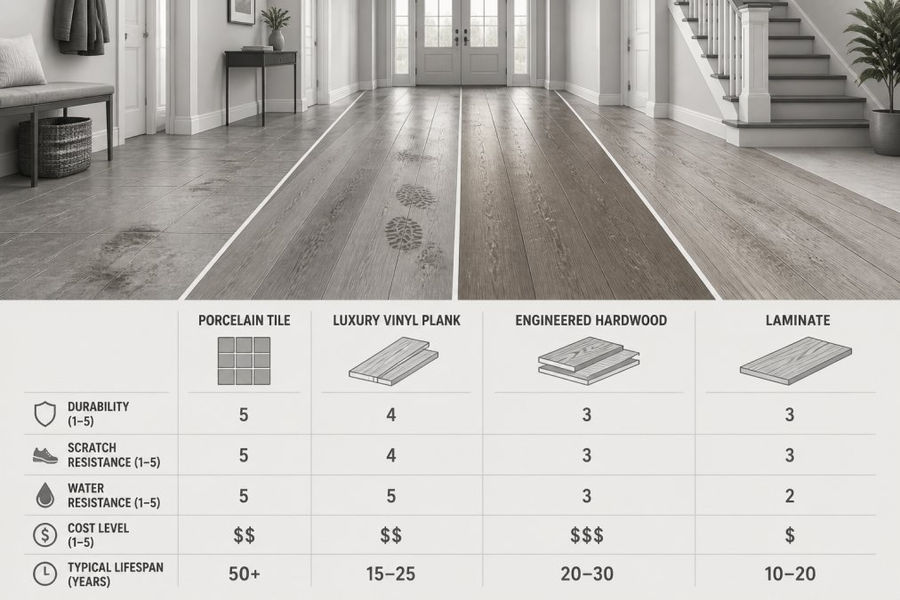
Porcelain Tile: Impact Resistance and Longevity
Porcelain tile ranks among the most durable flooring options available. Made from dense ceramic material fired at extremely high temperatures, porcelain resists scratching, staining, and moisture penetration far better than standard ceramic tile. Its non-porous surface means spills don't seep into the material.
Properly installed porcelain floors routinely last 25 to 30 years with minimal maintenance. PEI ratings typically fall between 4 and 5 for commercial-grade porcelain, making it suitable for the heaviest traffic. Grout lines between tiles remain a maintenance consideration.
Porcelain requires proper subfloor preparation and professional installation to prevent cracking. Grout maintenance is an ongoing responsibility. For spaces where durability matters, porcelain delivers unmatched performance.
Luxury Vinyl Plank (LVP) and Tile (LVT): Resilient Flooring Benefits
Modern LVP and LVT products feature a wear layer, a transparent protective coating measured in mils, that determines scratch and stain resistance. Wear layers of 20 mils or thicker provide excellent protection for high-traffic zones. The core material absorbs impact better than rigid alternatives, reducing sound and providing comfort.
LVP mimics the appearance of hardwood or stone while offering superior moisture resistance. Installation is faster and less invasive than tile or hardwood. Many homeowners and contractors prefer LVP for kitchens and bathrooms because of its water resistance.
Once the wear layer is compromised, the underlying material deteriorates rapidly. Luxury vinyl also softens under prolonged heat exposure. For high-traffic residential applications, LVP with a 20+ mil wear layer performs well, but won't match the lifespan of porcelain or properly maintained hardwood.
Engineered Hardwood: Durability in High-Traffic Residential Spaces
Engineered hardwood combines a real wood veneer with a plywood core, reducing wood movement that causes cupping and warping. The real wood surface can be refinished multiple times, extending floor life significantly.
Engineered hardwood with a thick wear layer (at least 2 millimeters) performs well in high-traffic residential spaces. The ability to refinish the surface means a worn floor can be restored to like-new condition rather than replaced.
Engineered hardwood requires careful maintenance. Water damage is a serious risk, and heavy impact can damage the veneer. Compared to porcelain or luxury vinyl, it demands more active care and periodic refinishing.
Laminate Flooring: AC Ratings and Wear Layer Protection
Laminate flooring uses a photographic layer beneath a clear wear layer to mimic wood or stone. AC4 and AC5 laminates are designed for high-traffic environments and perform well in residential high-traffic zones.
Laminate offers affordability combined with reasonable durability. A quality AC4 or AC5 laminate resists scratching and staining at a lower price point. Installation is straightforward.
Laminate cannot be refinished and must be replaced once the wear layer is compromised. Moisture exposure is problematic, laminate swells and delaminates if water penetrates seams or surface. It works best in dry spaces where moisture exposure is minimal.
Epoxy Flooring: Commercial-Grade Durability
Epoxy flooring consists of resin applied directly to concrete, creating a seamless, non-porous surface. It resists impact, abrasion, chemicals, and moisture penetration far better than any other material. Properly applied epoxy can last 10 to 20 years with minimal maintenance.
Epoxy offers exceptional durability, easy cleaning, and a seamless surface that eliminates grout lines and seams. For high-traffic areas where durability is paramount, epoxy delivers unmatched performance.
Epoxy requires professional installation and proper surface preparation. The concrete substrate must be clean, dry, and structurally sound. Once installed, epoxy is difficult to remove or repair if damage occurs.
Subfloor Preparation: The Foundation for Floor Longevity
The most overlooked factor in floor durability is subfloor preparation. Even the most durable material fails prematurely if installed on an inadequate or damaged subfloor.
Proper subfloor preparation begins with assessment. The subfloor must be structurally sound, level within 3 millimeters over 3 meters, and dry. For moisture-prone areas, a moisture barrier is essential. Moisture testing should be performed before installation.
Underlayment selection varies by material. Porcelain tile requires a cement backer board and mortar bed. Luxury vinyl benefits from foam underlayment for sound dampening. Engineered hardwood requires a moisture barrier and acclimation period. Epoxy requires thorough concrete preparation.
The investment in proper subfloor preparation pays dividends in durable flooring high traffic longevity. Rushing this step to save money or time is the fastest way to ensure premature failure. The investment in proper subfloor preparation pays dividends in durable flooring high traffic longevity. Rushing this step to save money or time is the fastest way to ensure premature failure.
Watch Out Installing flooring over a damaged or improperly prepared subfloor will void most manufacturer warranties and guarantees. The cost of correcting subfloor problems after flooring installation is installed is significantly higher than addressing them beforehand.
What to Ask Flooring Contractors Before You Decide
Selecting the right contractor is as important as selecting the right material. The wrong contractor can install a durable material poorly, resulting in premature failure. Before committing to any flooring project, ask these critical questions.
What is your experience with high-traffic installations? Contractors experienced with high-traffic flooring understand the specific demands of these spaces and know which materials perform best. They've seen failures and successes firsthand.
Can you provide references from high-traffic installations? Legitimate contractors readily provide references. Contact previous clients and ask about durability, maintenance, and whether the floor performed as expected.
What subfloor preparation will you perform? Ask specifically about moisture testing, leveling, and underlayment. The answer reveals whether the contractor prioritizes durability or cuts corners.
What warranty do you offer, and what does it cover? Understand what the contractor guarantees versus what the manufacturer guarantees. A contractor who stands behind their work offers meaningful warranties.
How will you handle project tracking and communication? Clear communication prevents surprises. Ask how you'll receive updates, who to contact with questions, and how timeline changes are managed. Clear communication prevents surprises. Ask how you'll receive updates, who to contact with questions, and how timeline changes are managed.
What is the total project cost, and what is included? Request a detailed breakdown of materials, labor, and any additional costs.
How to Maintain High-Traffic Floors for Maximum Lifespan
Material durability is only half the equation. Proper maintenance determines whether a floor reaches its full lifespan or deteriorates prematurely. Different materials require different maintenance approaches.
Life-Cycle Cost Analysis: Beyond the Initial Price
Comparing flooring options based on initial cost alone is a common mistake that leads to expensive failures. A comprehensive life-cycle cost analysis accounts for material cost, installation, maintenance, and replacement frequency.
Frequently Asked Questions
What is the most durable flooring for high-traffic areas?
Porcelain tile and epoxy flooring offer the highest durability ratings for high-traffic zones. Porcelain resists scratches, dents, and moisture with a PEI rating of 3-4, while epoxy provides commercial-grade protection with exceptional impact resistance. Luxury vinyl plank (LVP) with a wear layer of 12 mil or thicker ranks second. Your choice depends on whether you prioritize water resistance (porcelain), resilience (LVP), or maximum durability (epoxy).
How do I determine the durability rating of flooring?
Check the AC rating for laminate (AC3 to AC5, where AC5 is highest) and the PEI rating for tile (1-5, with 5 being most durable). For luxury vinyl, look at wear-layer mil thickness, 12 mil or more indicates commercial-grade durability. Porcelain tiles are graded by water absorption and hardness. When discussing options with flooring contractors, ask for these specific ratings in writing so you can compare materials objectively.
Is epoxy flooring a good choice for high-traffic residential spaces?
Yes. Epoxy flooring durability exceeds most residential options, offering scratch resistance, stain resistance, and moisture barriers that protect the subfloor. It requires professional installation to ensure proper curing and adhesion. Maintenance is minimal, regular sweeping and occasional damp mopping keep it looking new. The main trade-off is cost and the need for expert installation, but the long-term durability and low maintenance schedule make it worthwhile for busy households.
What maintenance is required to keep high-traffic floors looking new?
Maintenance varies by material. Porcelain and tile need regular grout maintenance to prevent staining. Luxury vinyl and laminate require damp (not wet) mopping and immediate spill cleanup to prevent water damage. Hardwood needs periodic refinishing every 7-10 years. Epoxy requires sweeping and occasional neutral-pH mopping. All materials benefit from protective mats at entry points and a consistent cleaning schedule. Ask your flooring contractor for a specific maintenance guide tailored to your chosen material.
Get Started Today


Comments