How to Clean Epoxy Garage Floors: 2026 Care Guide
Table of Contents
Why Epoxy Garage Floors Need a Different Cleaning Routine
Tools and Equipment Needed to Clean an Epoxy Garage Floor
What You'll Need Before You Start
Step-by-Step: How to Clean Epoxy Garage Floors
Weekly Spot Cleaning (10 Minutes)
Monthly Deep Clean
How to Remove Salt Stains From Garage Floors
Best Cleaning Products for Epoxy Floors (and What to Avoid)
Cleaning Agents to Avoid
Epoxy Floor Maintenance Schedule for Every Season
Troubleshooting: Scratches, Dulling, and Damage
Dirty vs. Damaged: The Quick Test
Common Problems and What They Actually Mean
When to Stop Cleaning and Call a Pro
Smart Home Tech on Epoxy
Frequently Asked Questions
Last Updated: September 25, 2026
Why Epoxy Garage Floors Need a Different Cleaning Routine
Epoxy garage floors are a cured resin coating, not bare concrete, and that single fact changes everything about how you clean them. This guide from Northern Escapes Services walks through how to clean epoxy garage floors without dulling the finish or shortening the coating's life.
Most people treat an epoxy floor like a concrete slab. They grab a stiff broom, a harsh cleaner, and scrub hard. That approach works on raw concrete. On epoxy, it slowly wears away the shine you paid for.
The difference comes down to the surface itself. Epoxy forms a sealed, non-porous layer over the concrete. Dirt and oil sit on top rather than soaking in. That makes everyday cleanup easier. It also means the wrong product can attack the coating directly.
So the routine shifts from "scrub hard" to "clean gently and often." Below, we'll show you exactly how to do that, step by step, plus the products that help and the ones that quietly ruin floors.
Key Takeaway Epoxy floors are sealed, not porous. Clean them gently and often instead of scrubbing hard, and they hold their finish far longer.
Tools and Equipment Needed to Clean an Epoxy Garage Floor
The right kit for an epoxy floor is simple and cheap. You need a few soft tools, a pH-neutral cleaner, and warm water. Skip anything abrasive.
What You'll Need Before You Start
Gather these before you begin:
pH-neutral cleaner made for coated floors
Soft nylon brush or a deck brush with soft bristles
Microfiber mop or a soft sponge
Squeegee for pushing water out
Two buckets: one for cleaner, one for rinse water
Warm water
Microfiber cloths for spot cleaning
A floor machine with a white pad helps on large floors, but it's optional for most home garages.
Avoid steel wool, scouring pads, and stiff wire brushes. They scratch the coating and leave surface dulling that never buffs out.
Step-by-Step: How to Clean Epoxy Garage Floors
Here's the full process, from a quick weekly wipe-down to a monthly deep clean. Most garages need only the short version.
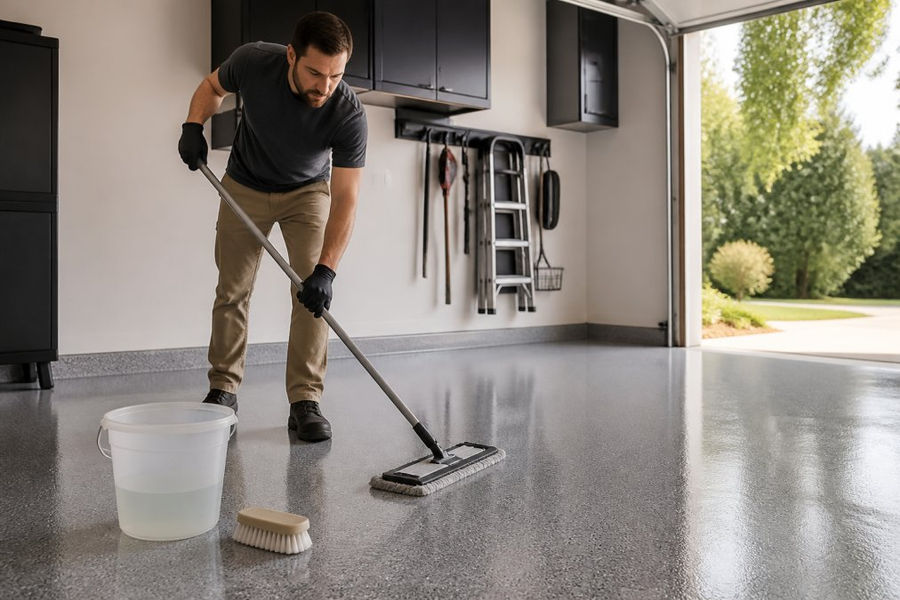
Weekly Spot Cleaning (10 Minutes)
Sweep or blow out loose debris removal first.
Mix a diluted solution of pH-neutral cleaner and warm water.
Wipe spills and tire marks with a microfiber cloth.
Rinse the area with clean water.
Dry with a squeegee or cloth.
This keeps grit from grinding into the finish between deeper cleans.
Monthly Deep Clean
Clear the garage completely.
Sweep the whole floor.
Apply your diluted cleaner in sections.
Scrub gently with a soft brush or white pad.
Rinse with clean water.
Push water out with a squeegee.
Let it air dry fully.
Work in sections so the cleaner never dries on the surface. Dried cleaner leaves streaks.
How to Remove Salt Stains From Garage Floors
Salt residue shows up as a white, chalky film, and it's one of the most common problems on epoxy in cold climates. The fix is warm water and patience, not harsh chemicals.
Mix warm water with a small amount of pH-neutral cleaner. Apply it to the salt residue and let it sit for a few minutes. Then wipe with a microfiber cloth and rinse.
For stubborn salt stains, repeat the process rather than scrubbing harder. A soft nylon brush helps lift dried film without scratching.
Rinse thoroughly afterward. Leftover salt pulls in moisture, which works against the finish integrity over time. A squeegee and a dry cloth finish the job.
Pro Tip Salt film returns fast in winter. A quick warm-water rinse once a week beats one deep scrub at the end of the season.
Best Cleaning Products for Epoxy Floors (and What to Avoid)
A pH-neutral cleaner is the best choice for epoxy floors because it lifts dirt without attacking the coating. Warm water and a mild degreaser handle most messes.
For greasy spots, use a citrus-based degreaser made for coated surfaces.
Cleaning Agents to Avoid
Some products cause real damage. Skip these:
Abrasive cleaners that scratch the surface
Ammonia-based products that dull the shine
Solvent-heavy degreasers not rated for coatings
Bleach in strong concentrations
Anything labeled "heavy-duty" for bare concrete
These strip the protective layer and speed up surface dulling. Once the gloss is gone, it doesn't come back with a mop.
Epoxy Floor Maintenance Schedule for Every Season
Season | Main Threat | Key Task | Frequency |
Spring | Road grit, mud, leftover de-icing film | Full deep clean, then a warm-water rinse | Once, after the last hard freeze |
Summer | Dust, tire marks, UV exposure through an open door | Spot clean and sweep; wipe tire marks while fresh | Weekly |
Fall | Leaves, grit, early moisture | Debris removal and sweep before grit gets ground in | Weekly |
Winter | Salt residue, slush, standing moisture | Warm-water rinse and squeegee dry | Weekly, or after any heavy tracking |
Pro Tip A five-minute weekly rinse in winter does more for coating life than a single aggressive scrub in spring. Consistency beats intensity on epoxy.
If you want a simple rule: sweep weekly, spot-clean as spills happen, deep clean once per season, and rinse more often whenever salt or grit is in play.
Troubleshooting: Scratches, Dulling, and Damage
Most epoxy problems trace back to cleaning habits, but the first job is telling the difference between a floor that's dirty and a floor that's damaged. Those need opposite responses, and treating one as the other makes things worse.
Dirty vs. Damaged: The Quick Test
Wipe a small area with a microfiber cloth and warm water, then let it dry completely. If the surface looks even and the gloss returns, it was dirt or film. If a mark stays after drying, it's in or on the coating itself.
Dirt and film sit on top and lift with a pH-neutral cleaner and a soft cloth.
Stains have bonded to the surface and need dwell time, not pressure.
Damage has changed the coating itself: the gloss is gone, the texture is different, or you can feel a groove with a fingernail.
Common Problems and What They Actually Mean
Fine scratches: caused by grit and stiff brushes. Sweep more often and use soft tools only. Shallow scuffs in the surface layer often look worse than they are because they scatter light.
Dulling: usually from ammonia-based or abrasive cleaners, or from repeated scrubbing in one spot. Switch to pH-neutral products and stop scrubbing; wipe instead.
White film: leftover salt, dried cleaner, or hard-water minerals. Rinse with warm water and dry with a squeegee rather than letting it air-dry.
Cloudy or hazy patches: often moisture trapped under or against the coating, not surface dirt. Improve drying and wipe up standing water promptly.
Stains that won't lift: repeat gentle cleaning with dwell time instead of scrubbing hard. Heat and pressure push stains deeper; patience lifts them.
Yellowing: typically a reaction to UV exposure over time, not a cleaning problem. It won't reverse with any product.
When to Stop Cleaning and Call a Pro
For deeper scratches, gouges, or epoxy coating that's peeling or lifting at the edges, cleaning won't help. Those are coating failures, and a repair is a job for a pro. A resin flooring specialist can assess the chemical resistance of the existing coat and match a repair to it, which matters because a patch that cures differently from the original will show as a visible seam.
Watch Out Scrubbing a stain with an abrasive pad removes the gloss permanently. You can't buff epoxy back to a shine the way you can with some finishes, so a two-minute shortcut can cost you the whole panel.
Smart Home Tech on Epoxy
A robot vacuum can help with daily debris removal on smooth epoxy, but check the wheels and brushes first. Hard wheels and aggressive beater brushes can mark the surface, and a vacuum that drags grit around does more harm than good. Soft rubber wheels and a vacuum-only mode are the safer pick. Run it dry, never wet, and keep the brushes clean so they don't grind grit into the finish.
Frequently Asked Questions
What is the best cleaner to use on epoxy garage floors?
A pH-neutral cleaner diluted in warm water handles most routine cleaning without dulling the finish. For greasy patches, use a citrus-based degreaser applied as a spot treatment, then rinse. Avoid ammonia-based and abrasive cleaners, which strip the topcoat and leave the surface looking chalky. Keep a dedicated microfiber mop and a soft nylon brush on hand so you never need to scrub hard enough to scratch the coating.
Can you use a pressure washer on epoxy garage floors?
You can, but only on a low setting and never close to the surface. High pressure forces water into seams and any small chips, which lifts the coating from underneath. If you do use one, keep the nozzle at a wide angle, move steadily, and follow with a squeegee to clear standing water. For most homeowners, a deck brush and a hose rinse are safer and just as effective for routine cleaning.
How do you remove oil stains from an epoxy garage floor?
Blot fresh oil with paper towels first, then apply a citrus-based degreaser or a paste of baking soda and warm water. Let it sit 10 to 15 minutes, agitate with a soft nylon brush, and rinse with warm water. Repeat for older stains. Never reach for a wire brush or abrasive pad, since both scratch the clear coat and create dull patches that trap future dirt.
How often should you clean your epoxy garage floor?
Sweep or use a microfiber mop weekly to clear grit and debris, and plan a deeper clean once a month with a pH-neutral solution and a deck brush. In winter, rinse salt residue as soon as the floor dries out, since road salt left sitting dulls the finish. A written epoxy floor maintenance schedule keeps these tasks consistent and protects the coating for years.
Get Started Today


Comments